


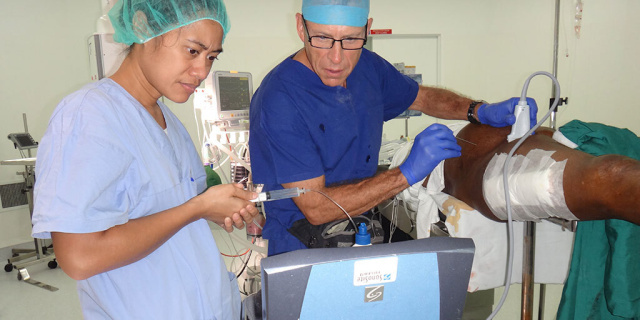
Sonosite M-Turbo Heads to Fiji on a Successful Medical Mission
Dr. David B. Goodie, a Specialist Anesthetist with the Fiji Orthopaedic Outreach, recently returned from a weeklong charitable medical mission in Fiji. For this mission, Sonosite lent Dr. Goodie an M-Turbo, which he promptly put to good use at the Lautoka Hospital in Fiji. He writes:
"[Sonosite] devices have proved invaluable in our work, and since I am the only anesthetist going on this occasion, an essential item for me to keep up with the workload…The members of the Orthopaedic Outreach team are once again indebted to Sonosite for the kind loan of an M-Turbo Ultrasound for its most…
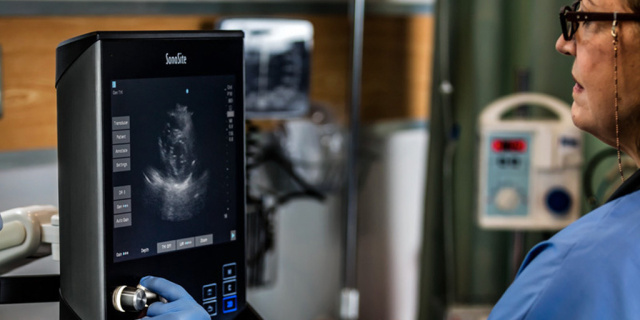
Top New Delhi Pediatrician Uses Sonosite to Promote Ultrasound
The Economic Times Healthworld recently interviewed Dr Vikas Kohli, an American Board Certified Pediatric Cardiologist with more than 20 years of experience. Based in the Delhi Child Heart Center in New Delhi, Dr. Kohli practices non-invasive, interventional pediatric cardiology and fetal cardiology. He has worked in premier medical centers as well as villages in India’s remotest areas. He spoke about how he uses ultrasound in his practice, and why he prefers Sonosite devices.Dr. Kohli feels that ultrasonography is an essential part of any ICU.“I believe that for echocardiography,…
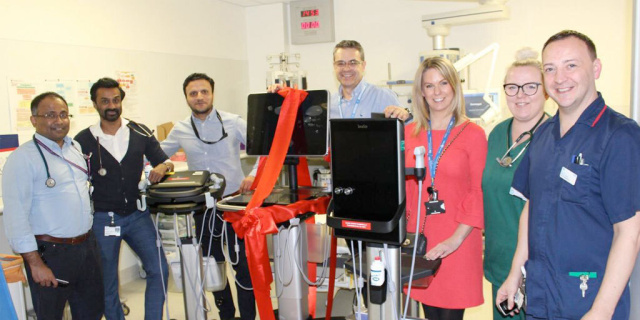
East London Hospital Staff Applaud the Arrival of Their New Sonosite Machines
The Queen’s Hospital Emergency Department in Romford is showing off their four new Sonosite point-of-care ultrasound (POCUS) machines which will allow them to examine patients quickly and accurately. Queen's Hospital, one of the busiest emergency wards in London, has a total of six Sonosite ultrasound machines.
The portable POCUS machines are critical because they allow hospital staff to bring imaging directly to the patient’s bedside so that doctors have immediate ultrasound imaging available for decision making and diagnosis.
Emergency Department consultant Darryl Wood is…
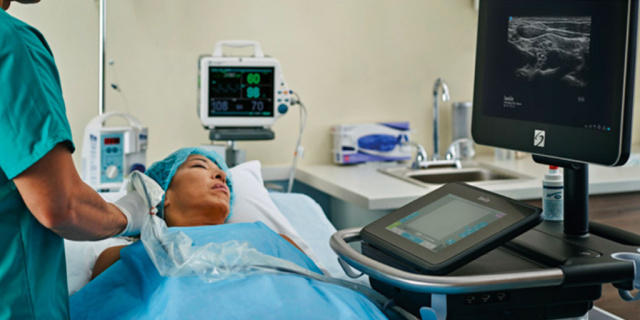
Multimodal Analgesia Pain Management Strategies in the ICU
The use of opioids in the ICU and the post-operative period is common, with patients often receiving opioids even after simple surgeries. Though opioids are effective in providing fast pain relief, the side effects of respiratory depression, cough suppression, confusion, drowsiness, nausea, vomiting and potential addiction make the sole reliance on opioids risky.
ICU clinicians are formulating more effective strategies to manage patient pain while minimizing the risks. In an article published in ICU Management and Practice, Dr. Xavier Capdevila, Head of the Department of Anesthesia and…

Ultrasound for Elephant Medicine
India and Southeast Asia are home to the endangered Asian elephant, which is rapidly declining in numbers due to poaching and habitat destruction.In Myanmar, there are currently around 5,000 wild elephants, and another 3,500 that have worked in the logging industry carrying timber – an activity prohibited under new legislation. Eight of these ‘unemployed’ elephants are now cared for by Green Hill Valley, a local park on a mission to educate residents and visitors, while providing the elephants with vital veterinary care. Willem Schaftenaar, Veterinary Advisor to the Elephant Taxon Advisory…

In Case of Emergency, Use POCUS
Time is of the essence in the emergency department, where a prompt diagnosis can literally mean the difference between life and death.In this environment, access to point-of-care ultrasound is essential, providing vital information to help clinicians rapidly determine the most appropriate course of action for emergency patients. Dr. Martin Langer, clinical lead for emergency medicine at the Evangelisches Krankenhaus Unna, describes the importance of ultrasound in his department.The Evangelisches Krankenhaus Unna is a 324-bed, district hospital in Germany that includes a certified stroke unit…

Keeping Players on the Field with the Aid of Ultrasound
Professional sportsmen and women rely on rapid, accurate assessment and treatment of injuries to allow them to regain match fitness and return to the field at the earliest opportunity.At Harlequin FC rugby club, point-of-care ultrasound complements physical examination as an aid to diagnosis, as team doctor Courtney Kipps explained. Harlequins is an English Premiership rugby union team based in Twickenham. The club’s medical team needs to ensure that the pool of players available for selection on match days is as large as possible. This not only involves maintaining the current health and…
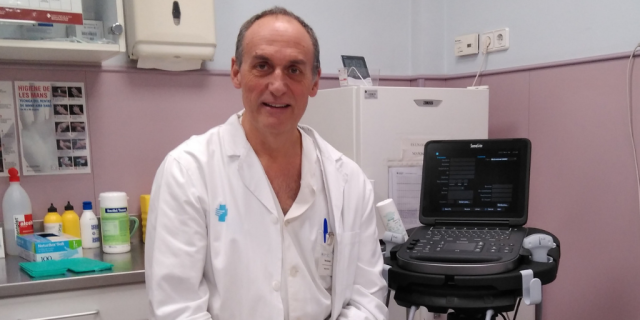
The Growth of Portable Ultrasound in Primary Care
In the last decade there has been a widespread adoption of portable ultrasound in point of care (POCUS) for primary care.Its potential for timely assessment and rapid diagnosis continues to attract family doctors, and more and more are getting the necessary training to offer this enhanced service to their local communities. Dr. Pere Guirado, a family doctor based in Catalonia (Spain), has always been an advocate for the use of POCUS in primary care, and describes his goal of becoming common in the country."After working for many years in medicine and exercising directive functions…
Positive Impacts of Ultrasound-Guided Regional Anesthesia on Enhanced Recovery Pathways
AnesthesiologyNews.com
Theresa Bowling, MD
Enhanced recovery pathways (ERPs) have been shown to reduce costs and improve outcomes in nearly all surgical specialties, including shortening length of stay (LOS) by 30% to 50%, with similar reductions in complications and decreased readmissions. Compared with traditional care, ERPs have resulted in a cost savings of $6,900 to $7,129 per patient. This evidence-based approach to standardizing care of the surgical patient with best practices often includes regional anesthesia techniques, including ultrasound-guided regional anesthesia (UGRA), that…
The "One-Stick" Standard for Vascular Access
HealthManagement.org
Nidhi Nikhanj, MD
Obtaining vascular access is one of the most common procedures performed in U.S. hospitals, with more than 5 million central venous catheterizations (CVCs) performed annually (Feller-Klopman 2007). Nearly 80% of critical care patients undergo CVC (Gibbs; Murphy 2006) for administration of fluids, blood products, or vasoactive drugs; hemodynamic monitoring; hemodialysis or transvenous pacing during an inpatient stay (Sisson; Nagdev 2007). To learn how to reduce complications, such as central line associated blood stream infections, with placing a CVC…
The Future of Pediatric Imaging
Diku Mandavia, MD, FACEP, FRCPC, Chief Medical Officer at FUJIFILM Sonosite
HealthCare Business News
While providers continue to adhere to safe, low-dose imaging protocols, we are also seeing a trend toward finding new care pathways that use ionizing-free modalities. For example, more clinicians are opting to use point-of-care ultrasound over CT to diagnose appendicitis in children because it’s safer and has a very high accuracy rate. Many pediatric emergency physicians are an ultrasound-first philosophy because it delivers a speedier diagnosis. It’s less costly, safer, painless, and…
Study: POCUS Saves Time, Money, in Family Practice
According to a systematic review recently published in Annals of Family Medicine, point-of-care ultrasound can not only reduce costs, but can also be adopted by physicians relatively quickly, especially with the most basic exams.
“Point-of-care ultrasound empowers the primary care physician by providing more diagnostic information or increasing precision in clinical procedures,” said Camilla Aakjær Andersen, MD, of Aalborg University Fyrkildevej in Denmark, to Healio Primary Care Today.
“Our review showed that competence in some simple examinations can be achieved after only a few…

New Study: POCUS Saves Time, Money, in Family Practice
According to a systematic review recently published in Annals of Family Medicine, point-of-care ultrasound (POCUS) can reduce costs and improve diagnostic abilities in family medicine and other clinical settings.
In an article on Healio Primary Care Today, the study's author, Camilla Aakjær Andersen, MD, of Aalborg University Fyrkildevej in Denmark, explained that POCUS "empowers the primary care physician by providing more diagnostic information or increasing precision in clinical procedures."
In addition to high specificity and sensitivity, Andersen says that the 51 studies…

POCUS Profile: Dr. Jennifer Hanko
Point-of-care ultrasound (POCUS) is widely used in nephrology for guiding the creation of fistulas and informing decisions on their viability and performance for dialysis. Dr. Jennifer Hanko is a consultant nephrologist at Belfast City Hospital, a 900-bed modern university teaching hospital in Belfast, Northern Ireland. Here, she explains the impact of POCUS on her clinical practice and describes the benefits, for both staff and patients, of using POCUS.I originally learned to use ultrasound for vascular mapping and arteriovenous (AV) fistula assessment during a fellowship in…
POCUS Profile: Dr. Justin Kirk-Bayley
Point-of-care ultrasound systems play an important role in the treatment of complicated medical cases at the Royal Surrey County Hospital in Guildford, as consultant intensivist and anaesthetist Dr. Justin Kirk-Bayley explained.
The Royal Surrey County Hospital is a 527-bed general hospital and a specialist tertiary centre for cancer, oral and maxillofacial surgery and pathology. As a major cancer centre, the hospital treats some very difficult and complicated patients, and so has a larger than average 28-bed intensive care unit (ICU). The hospital is also a national leader…

In-flight Ultrasound Changes Medical Outcome
STARS (Shock Trauma Air Rescue Service) Air Ambulance is a non-profit emergency air transport organization* that serves rural communities in British Columbia and Alberta, Canada.
Funded by donations from private individuals, STARS was founded by Dr. Gregory Powell, who had seen the difference that helicopter transport could make in patient outcomes as an observer in a M.A.S.H. unit during the Vietnam War.
In May of 2017, patient Ron Diller collapsed upon arrival at his local hospital. STARS was dispatched to transport Diller by helicopter to the nearest hospital.
During transport, an…

Point-of-Care Ultrasound on Mt. Everest
Dr. Luanne Freer is, to put it mildly, comfortable with being uncomfortable.A trained emergency medicine physician who grew up in the Washington DC area, Dr. Freer serves as medical director of Yellowstone National Park through Medcor Inc. When she’s not busy with her full-time job, or volunteering to save lives in Sierra Leone’s Ebola outbreak, you might find her working at the emergency clinic that she founded, Everest Base Camp Medical Clinic (Everest ER).During the annual climbing season, which usually runs from April through May, Dr. Freer collaborates with Nepali and foreign doctors;…

Teaching USGRA in Papua New Guinea
An advocate for the expansion of the use of point-of-care ultrasound, Dr. Yasmin Endlich is an anesthesiologist who practices medicine in Australia and regularly travels to Papua New Guinea to provide medical training to local physicians. Here, she explains why nerve blocks are a crucial tool in a rural anesthetist’s arsenal:Papua New Guinea, a country of over 8 million people, is looked after by less than 30 anesthetists, half of whom are still in training. Not coincidentally, I have actually met every anesthetist in Papua New Guinea.This year, the 54th Medical Symposium was held in…

Doctors Without Borders: Using Point-of-Care Ultrasound in Sudan
Dr. Achai Bulabek is a clinical officer with Médecins Sans Frontières (MSF). At age 28, she is currently serving a region between Sudan and South Sudan (her native country). Her hospital recently adopted a point-of-care ultrasound system (POCUS) that is now frequently used to diagnose patient trauma and guide needle-based procedures such as paracentesis and thoracentesis.In a blogpost on the MSF website, Dr. Bulabek describes several cases in which the use of POCUS helped diagnose and treat patients quickly and effectively."Since we started using the new ultrasound, something has changed…
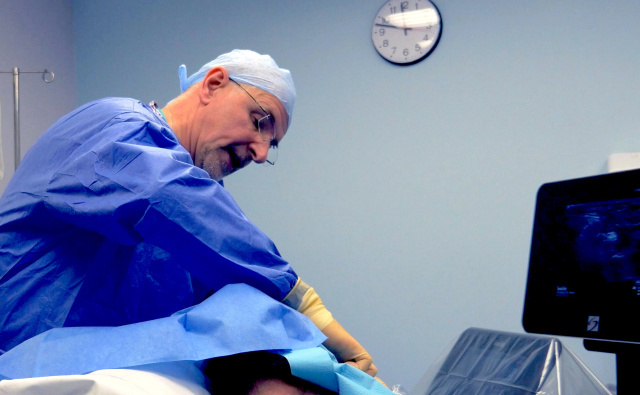
Point-Of-Care Ultrasound Helps Make Regional Anesthesia Quicker And Safer
Ultrasound-guidance has proven invaluable for the regional neurosurgical center at the Salford Royal Hospital outside Manchester, England. In addition to helping to improve patient safety, ultrasound is increasingly being used to guide regional anesthesia, offering a variety of benefits.Jim Corcoran, consultant neuroanesthetist and clinical director for perioperative care at the Salford Royal, says that ultrasound-guidance also allows anesthetists to reduce the amount of anesthetic required to effectively block a nerve region (10-20 ml versus 30-40 ml using landmark/nerve stimulation…