


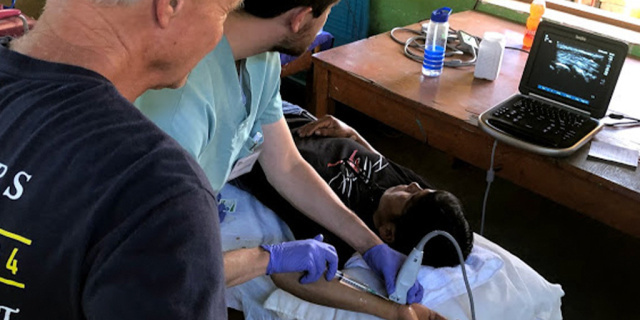
Doctor Uses Ultrasound-Guided Injections to Treat Peruvian Farmers
Sports medicine specialist Dr. David Sealy, MD CAQSM works with the Volunteers in Medical Missions, a Christian medical organisation that sends 15 to 18 medical missions a year to countries around the world. Dr. Sealy returned from a 10-day trip in the high Andes in Peru, visiting five villages over a five-day period to provide medical care. Dr. Sealy’s team included eight doctors, two nurses, a Pharm.D., and five more volunteers. Partnering with a church in Lima, his team set up clinics in schools, churches, posta medicas (small public health clinics), and other community buildings. They saw…
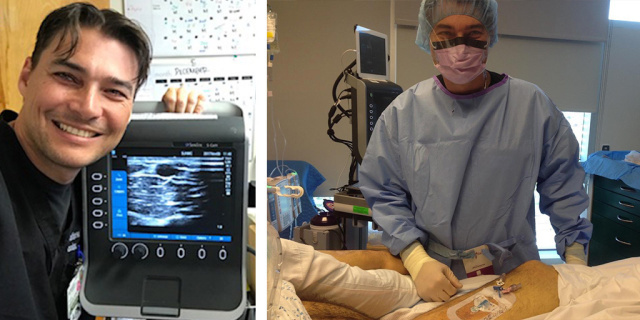
POCUS Profile: Nurse Practitioner Matt Ostroff
Matt Ostroff, MSN APN VABC, the vascular access coordinator at St. Joseph’s Hospital in Paterson, New Jersey, is leading a revolution in point-of-care ultrasound (POCUS). Ostroff has helped pioneer a multi-disciplinary approach for vascular access, bringing different specialists to the patient bedside. Bedside vascular access saves patients pain, time, and expense, while greatly increasing safety. The medical community has taken notice. Dr. Benita Zahn of News13 in Albany, New York recently interviewed Ostroff about his groundbreaking work, where he discussed his “secret”—ultrasound-guided…
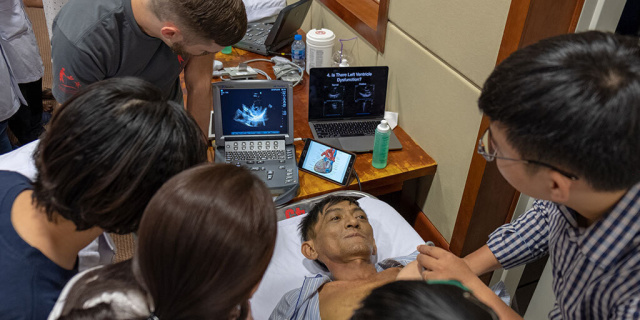
Ultrasound Helps Canadian Doctor Give Back to Her Two Countries
Emergency physician Dr. Chau Pham is the founder and Co-Chair of Canadians Helping Kids in Vietnam (CHKV), an organisation established in 1995 to help improve the lives of the poorest in Vietnam by improving conditions that directly empower children.
Dr. Pham knows all too well the challenges Vietnamese children face. She was a refugee herself, coming to Canada from Vietnam when she was seven years old in 1983. She was diagnosed with TB, and had to stay in a Thai refugee camp for treatment for a year before she was admitted into Canada. It was during this formative time that she came to…
What is ERAS (Enhanced Recovery after Surgery) and How Is It Supporting Better Patient Outcomes?
DOTMed HealthCareBusiness NewsPhilip Corvo, MD, MA, FACSDr. Philip Corvo serves as chairman of the Stanley J. Dudrick Department Surgery and Director of Surgical Critical Care at Saint Mary's Hospital, Trinity Health Of New England, located in Waterbury, Connecticut. He leads an innovative ERAS (Enhanced Recovery after Surgery) programme which is helping reduce opioid use, speeding patient recovery and reducing costs. DOTMed interviewed Dr. Corvo about the programme he leads, in which he discusses the financial impact of ERAS, how to establish an ERAS programme, and patient success stories.…
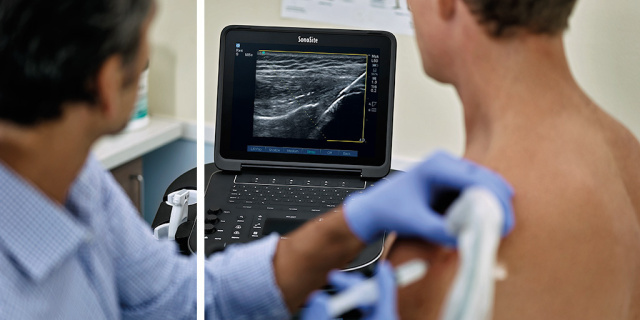
Pain Management Scientist Describes Benefits of Ultrasound-Guided Therapies
In a July 2019 article published in HealthManagement.org, Dr. Francois Louw M.D., clinical assistant professor at the Bill Nelems Pain and Research Centre at the University of British Columbia, Okanagan, described an extensive list of strategies to reduce opioid use in chronic pain clinics. Dr. Louw advocates for ultrasound-guided injection therapies, which he says is a safer, more effective alternative to opioids for chronic pain. He describes recent studies and case histories from his work at the Bill Nelems Centre, where he collabourated with nine doctors who logged in more than 11,000…

Letter from Uganda: Ultrasound Vital in OBGYN Care
Image courtesy of Acclaim Physician Group
Dr. Kent Brantly, a clinical faculty member of the John Peter Smith Family Medicine Residency in Fort Worth, Texas, recently returned from a medical mission in Kampala, Uganda. He loaned a portable ultrasound device from Sonosite, which proved indispensable for both clinical and educational purposes. He writes:
“I wanted to write to you to say thank you for the service provided by FUJIFILM Sonosite Global Health. I led a group of three residents from our program in Texas on a month-long international rotation in Kampala, Uganda, where we…
The World Needs More Ultrasound Machines
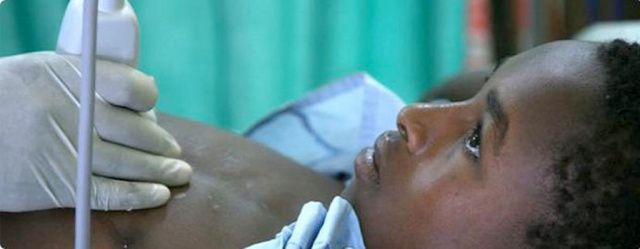
Ultrasound, CT scanners, and x-ray machines are medical technologies we generally take for granted. But in resource-limited areas around the world, access to these life-saving devices is severely limited. In a September 2017 feature in The Atlantic, medical writer Jason Silverstein described the challenges developing countries face without the benefit of point-of-care ultrasound devices, x-ray machines, and CT scanners.
Silverstein illustrated the stunning contrast between developing countries and one American city. Boston’s Massachusetts General Hospital alone has 126 radiologists1, while…
Restoring Hope by Reducing Pain and Disability
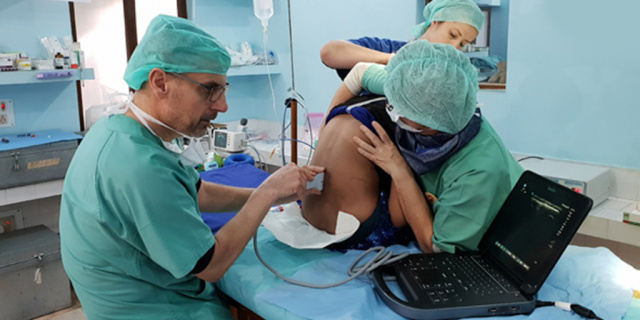
Asha Vihar is a development aid project in the state of Jharkhand, Eastern India that delivers free healthcare to those who need it most. Anesthetists Dr. Lukas Fischer and Dr. Peter Lembach volunteered at Asha Vihar’s annual surgical camp for children with musculoskeletal abnormalities. Dr. Fischer depended heavily on using point-of-care ultrasound (POCUS) to guide needle insertions and provide regional anesthesia, enabling life-changing interventions.
Many people in India cannot afford health insurance or pay for surgery that their child may have needed for many years. These families…
Sonographer Takes Sonosite Edge to Belize
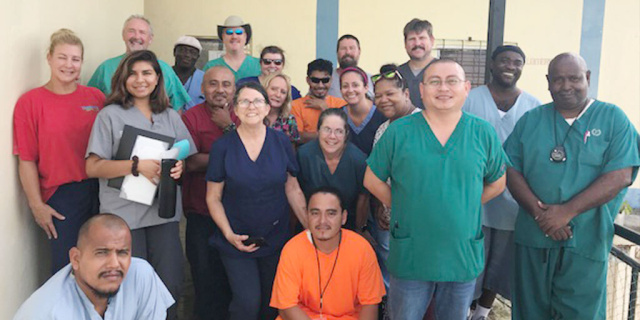
Deborah Majure RT, CV, RDMS, RCC is a diagnostic medical sonographer who knows the importance of ultrasound in resource-limited environments. She recently returned from a charitable medical mission to Belize, sent by First Presbyterian Church, Pascagoula, Mississippi, which is affiliated with Word at Work ministry. This was their fourth mission to Belize. Deborah came with a radiologist, nurse practitioner, resident nurse, pharmacist, and a construction team. She also brought a Sonosite Edge portable ultrasound machine with C60x and HFL38x transducers loaned from the Sonosite Global Loaner…
Seattle Emergency Clinician Brings Ultrasound to Rural Nigeria
Dr. Alaro Lawson DNP, emergency room provider at Harborview Medical Center in Seattle, returned from a medical mission to Bakana, Nigeria on behalf of the Kalabari National Association (KNA). She took with her two Sonosite Edge portable ultrasound machines, accompanied with C60x, HFL38X, HFL50X, ICTx, L25x, L38xi, P10x, C11x, and P21x transducers, provided by Sonosite’s Global Health Loaner Pool. This is the fourth year KNA has partnered with local Nigerian organizations to provide free healthcare to residents in rural, often neglected communities in the Niger Delta region. Dr. Lawson…

Sonosite Ultrasound the Star Attraction at AORA Conference
The Economic Times Healthworld.com covered FUJIFILM Sonosite’s exhibit of its latest ultrasound products at the 9th National Conference of Academy of Regional Anesthesia (AORA), organized by the Department of Anesthesia & Perioperative Care, Ganga Hospital from July 4-7, 2019 at Coimbatore, Tamil Nadu, India.
During the tradeshow at Le Meridien hotel, FUJIFILM Sonosite displayed their SII, Edge II, X-Porte, and iViz point-of-care ultrasound systems. The SII was the primary attraction during the main event and at the post-conference workshops.
Dr. T.V.S Gopal, President of AORA India…
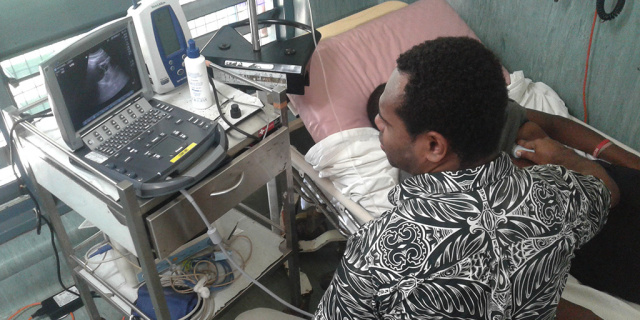
Sonosite M-Turbo Gets Plenty of Work in Vanuatu: Part One
Dr. Jonathan “Jono” Henry is an emergency physician based in Melbourne, Australia. After he gave a talk at the 2018 ASUM Conference in Auckland, Dr. Henry was asked by the Vanuatu Ministry of Health to assist with emergency services in their country. The Pacific archipelago nation is still struggling to emerge from a 2015 cyclone.For six months Dr. Henry was based at Northern Provincial Hospital, located in the city of Luganville on the island Espiritu Santo. This is Vanuatu’s second-largest hospital, serving a population of 160,000. Naturally, Dr. Henry knew a portable ultrasound…

Fujifilm Sonosite and Partners HealthCare Launch Artificial Intelligence Initiative
FUJIFILM Sonosite, Inc. announced the launch of a strategic relationship with Partners HealthCare to apply artificial intelligence (AI) to improve POCUS. The two companies will collaborate to use AI-based models that will assist clinicians in diagnosis and enhancing quality of care. The collaboration will be executed through the MGH & BWH Center for Clinical Data Science and leverage the extensive data assets, computational infrastructure, and clinical expertise of the Partners HealthCare system.
Rich Fabian, President and Chief Operating Officer of FUJIFILM Sonosite, Inc. said of the…
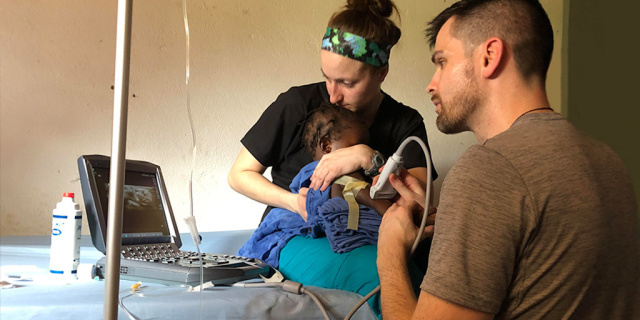
Medical Mission Uses Portable Ultrasound Machine in Liberia
Allison Byrne is a physical therapist and co-leader of a medical team from the Park Community Church in Chicago. She recently returned from a medical mission to assist the Light Evangelism Ministry (LEM) clinic in Fendell, Liberia. The LEM clinic provides diagnoses and treatment via IV and oral medications to any patients who come to be seen with only limited electricity from a generator.Allison’s team consisted of six people with various medical backgrounds (including a resident nurse, osteopath, and physician assistant) and two more people who primarily supported the ministry’s school. They…

Studies Show POCUS Saves Time for Pregnant Patients
In a March 2019 meta-analysis of eight studies published in the American Journal of Emergency Medicine, data shows that the use of pelvic point-of-care ultrasound (PPOCUS) can lead to pregnant patients spending less time in the Emergency Department. These decreased lengths of stay can help EDs and hospitals reduce crowding and enhance their quality of care1.
When examining a pregnant patient, emergency physicians must make a choice of performing either PPOCUS or a comprehensive ultrasound (CUS) through the radiology or gynecology departments. Access to CUS, however, varies widely by…
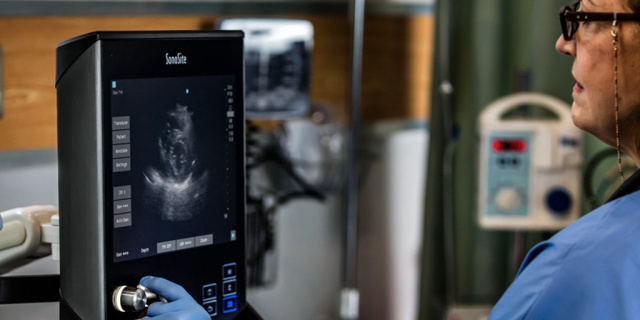
Top New Delhi Paediatrician Uses Sonosite to Promote Ultrasound
The Economic Times Healthworld recently interviewed Dr Vikas Kohli, an American Board Certified Paediatric Cardiologist with more than 20 years of experience. Based in the Delhi Child Heart Centre in New Delhi, Dr. Kohli practises non-invasive, interventional paediatric cardiology and foetal cardiology. He has worked in premier medical centres as well as villages in India’s remotest areas. He spoke about how he uses ultrasound in his practise, and why he prefers Sonosite devices.Dr. Kohli feels that ultrasonography is an essential part of any ICU.“I believe that for echocardiography…
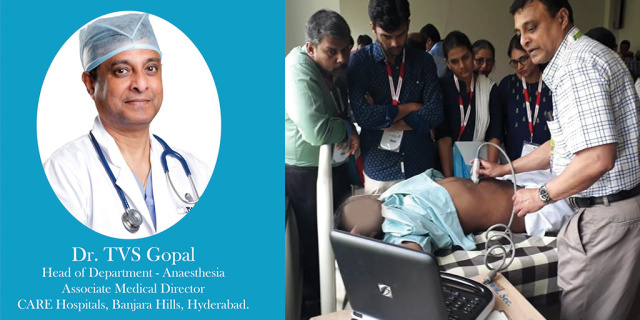
POCUS Profile: Dr. T.V.S. Gopal
Dr. T.V.S. Gopal, Head of the Department of Anaesthesia and Associate Medical Director at CARE Hospitals in Hyderabad, India, has been practicing for more than 30 years. In this recent interview, Dr. Gopal discusses how POCUS has transformed the craft of anaesthesiology and the many scenarios where he uses ultrasound.When did you start using ultrasound?I began my foray into ultrasound guided regional anaesthesia in year 2006 when I attended the Second Advanced Regional Anaesthesia & Ultrasound Guided Peripheral Nerve Block Course conducted by the Aesculap Academy in Tan Tock Seng Hospital…

Sonosite Systems Help Physicians Deliver Better Patient Care at Medanta
medanta-pic_finalImage.jpg
The Economic Times: Healthworld recently released a short documentary exploring how point-of-care ultrasound improves patient outcomes at Medanta Hospital - The Medcity in Gurugram, one of the leading multi-speciality hospitals in the Delhi-Capital region in India. In the documentary, Healthworld interviewed the point-of-care physicians at the hospital about their experience with POCUS.
The Medanta team is currently using the Sonosite M-Turbo and Sonosite Edge Color Doppler ultrasound systems. In the…
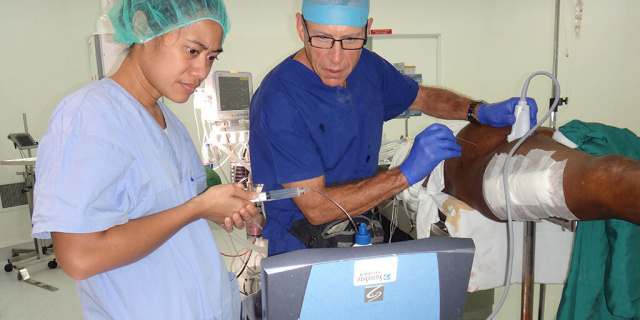
Sonosite M-Turbo Heads to Fiji on a Successful Medical Mission
Dr. David B. Goodie, a Specialist Anesthetist with the Fiji Orthopaedic Outreach, recently returned from a weeklong charitable medical mission in Fiji. For this mission, Sonosite lent Dr. Goodie an M-Turbo, which he promptly put to good use at the Lautoka Hospital in Fiji. He writes:
"[Sonosite] devices have proved invaluable in our work, and since I am the only anesthetist going on this occasion, an essential item for me to keep up with the workload…The members of the Orthopaedic Outreach team are once again indebted to Sonosite for the kind loan of an M-Turbo Ultrasound for its most…
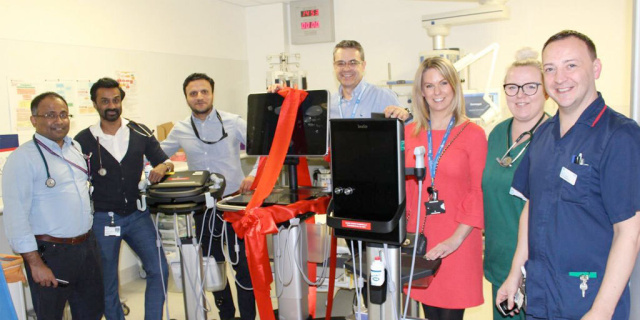
East London Hospital Staff Applaud the Arrival of Their New Sonosite Machines
The Queen’s Hospital Emergency Department in Romford is showing off their four new Sonosite point-of-care ultrasound (POCUS) machines which will allow them to examine patients quickly and accurately. Queen's Hospital, one of the busiest emergency wards in London, has a total of six Sonosite ultrasound machines.
The portable POCUS machines are critical because they allow hospital staff to bring imaging directly to the patient’s bedside so that doctors have immediate ultrasound imaging available for decision making and diagnosis.
Emergency Department consultant Darryl Wood is…