


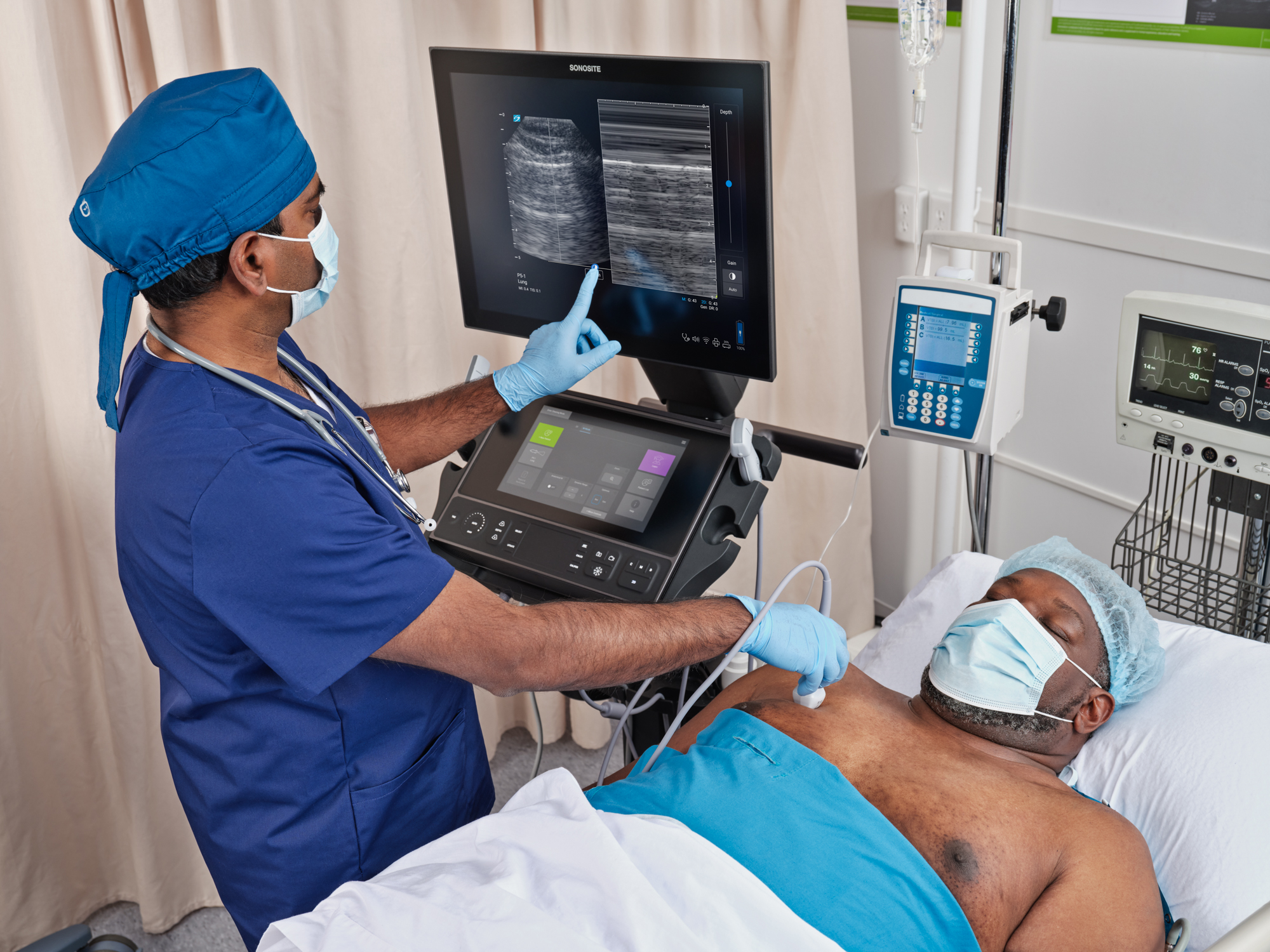
Phased array ultrasound transducers play a critical role in cardiac and thoracic imaging—especially in fast-paced, point-of-care environments. Whether in the emergency department, ICU, or perioperative setting, clinicians rely on phased array probes to deliver rapid, actionable insights at the bedside.
At FUJIFILM Sonosite, phased array transducers are designed specifically for point-of-care ultrasound (POCUS)—combining image performance, durability, and versatility to support confident clinical decision-making across a range of applications.
What Is a Phased Array Ultrasound Transducer?
A phased array ultrasound transducer uses electronic beam steering to create a sector-shaped image, allowing clinicians to visualize structures through narrow acoustic windows.
This design offers several key advantages:
- Small footprint for imaging between ribs (intercostal access)
- Deep penetration for cardiac and thoracic imaging
- Real-time imaging for dynamic assessments
Because of these capabilities, phased array probes are the primary choice for cardiac POCUS and are widely used in emergency medicine, critical care, and anesthesia.
Sonosite Phased Array Transducer Portfolio
P5-1 Phased Array Transducer
A versatile, general-purpose probe with a broad frequency range, the P5-1 phased array transducer is well-suited for adult cardiac imaging, abdominal and lung applications, and deep penetration in technically challenging patients.
P11-3 Phased Array Transducer
Designed for higher-resolution imaging, the P11-3 phased array transducer supports pediatric and neonatal cardiac imaging and applications requiring improved resolution at shallower depths.
Clinical Applications of Phased Array Ultrasound Probes
Cardiac Imaging
Detecting pericardial effusion and tamponade, assessing cardiac activity in arrest or shock, and evaluating ventricular function.
Emergency Medicine
Rapid shock assessment, FAST exam cardiac evaluation, and bedside triage.
Critical Care (ICU)
Serial cardiac monitoring, hemodynamic assessment, and volume status evaluation.
Anesthesia and Perioperative Care
Preoperative screening and hemodynamic evaluation.
Lung and Thoracic Imaging
Assessment of pleural effusion and detection of pneumothorax.
Pediatric and Neonatal Applications
Pediatric cardiac imaging and neonatal assessments.
Key Advantages of Sonosite Phased Array Transducers
Designed for Point-of-Care Environments
Durable and reliable for high-acuity settings.
Optimized for Intercostal Access
Small footprint for rib spaces.
Versatility Across Applications
Supports cardiac, lung, and abdominal imaging.
Broad Frequency Options
Supports both deep penetration and high resolution.
Seamless System Integration
Compatible with Sonosite PX, LX, ST, and MT
Workflow and Infection Control
Easy to clean and durable.
Supporting POCUS Program Growth
Standardization, training, and scalability.
Choosing the Right Phased Array Transducer
- Consider patient population, clinical setting, imaging needs, and program goals.
- Supporting confident cardiac imaging at the Point of Care
- Sonosite phased array transducers support fast, informed clinical decisions at the bedside.
Frequently Asked Questions
What is a phased array ultrasound probe used for?
A phased array ultrasound probe is primarily used for cardiac imaging (cardiac POCUS). It can also be used for thoracic, lung, abdominal, and select neurological applications, especially when deeper penetration and a small footprint are required.
Why is a phased array probe used for cardiac imaging?
Phased array probes are ideal for cardiac imaging because they have a small footprint that fits between the ribs and use beam steering to create a sector-shaped image. This allows clinicians to visualize the heart through narrow intercostal spaces.
What frequency is best for a phased array transducer?
Phased array probes typically operate in the 1–5 MHz range, which provides the deep penetration needed for adult cardiac imaging. Higher-frequency options (e.g., 3–11 MHz) may be used for pediatric or neonatal patients, where improved resolution is needed at shallower depths.
Can a phased array probe be used for lung ultrasound?
Yes. While linear probes are commonly used for lung imaging, phased array transducers can assess pleural effusions, pneumothorax, and pulmonary edema.
What is the difference between a phased array and curvilinear probe?
Phased array probes have a small footprint and are optimized for cardiac imaging and intercostal access, while curvilinear probes have a larger footprint and are typically used for abdominal imaging.
Which Sonosite phased array probe should I choose?
The right probe depends on your clinical needs: P5-1 for general adult cardiac use and P11-3 for pediatric ultrasound and neonatal cardiac imaging.
Are phased array probes suitable for POCUS programs?
Yes. Phased array probes are essential for cardiac POCUS programs and are widely used across emergency departments, intensive care units, and anesthesia settings.
How do Sonosite phased array transducers support workflow?
Sonosite phased array transducers are designed for point-of-care environments, supporting rapid bedside imaging, durability in high-acuity settings, easy cleaning, and compatibility across systems.
Supporting POCUS Program Growth
Standardization, training, and scalability.