


Dr. John Christian Fox and Joel Shlang discuss Medical Education, Sonosite's GLIMPSE Show
Lorem ipsum dolor sit amet, consectetur adipiscing elit. Vivamus fringilla mollis varius. Proin est tellus, congue eu sagittis id, suscipit eget mi. Phasellus non ligula vel erat facilisis adipiscing at et ligula. Maecenas eu nisl at magna egestas vestibulum. Fusce ligula leo, hendrerit convallis nibh ac, lobortis vulputate diam. Nullam gravida ac leo nec interdum. Vivamus quis neque quis ligula ultrices euismod. Nulla interdum, lacus luctus rhoncus euismod, velit augue tristique mi, vehicula tristique sem dolor nec lectus. Pellentesque non convallis ipsum. Aliquam rutrum blandit felis tempor…
Dr. Francis Yamazaki, Discusses Anesthesia on Sonosite's GLIMPSE Show
Lorem ipsum dolor sit amet, consectetur adipiscing elit. Vivamus fringilla mollis varius. Proin est tellus, congue eu sagittis id, suscipit eget mi. Phasellus non ligula vel erat facilisis adipiscing at et ligula. Maecenas eu nisl at magna egestas vestibulum. Fusce ligula leo, hendrerit convallis nibh ac, lobortis vulputate diam. Nullam gravida ac leo nec interdum. Vivamus quis neque quis ligula ultrices euismod. Nulla interdum, lacus luctus rhoncus euismod, velit augue tristique mi, vehicula tristique sem dolor nec lectus. Pellentesque non convallis ipsum. Aliquam rutrum blandit felis tempor…
Dr. Liz Turner discusses Visual Medicine on Sonosite's GLIMPSE show
Lorem ipsum dolor sit amet, consectetur adipiscing elit. Vivamus fringilla mollis varius. Proin est tellus, congue eu sagittis id, suscipit eget mi. Phasellus non ligula vel erat facilisis adipiscing at et ligula. Maecenas eu nisl at magna egestas vestibulum. Fusce ligula leo, hendrerit convallis nibh ac, lobortis vulputate diam. Nullam gravida ac leo nec interdum. Vivamus quis neque quis ligula ultrices euismod. Nulla interdum, lacus luctus rhoncus euismod, velit augue tristique mi, vehicula tristique sem dolor nec lectus. Pellentesque non convallis ipsum. Aliquam rutrum blandit felis tempor…
Interview with Chanel Fishetti - Glimps Show by Fujifilm Sonosite
Chanel Fischetti @Chanel_Fischetti
Chanel Fischetti grew up in Southern California and attended the University of Southern California in Los Angeles where she ran track and cross country. She is currently attending medical school at the University of California Irvine and plans to practice in the field of emergency medicine with a special focus in ultrasound and international health. Outside of medicine, Chanel loves to run, spend time with friends and family and work with the special needs community. Chanel is working on a new app called theraconnect.org
What if you could reduce door-to-balloon time for heart attack patients?
Read More from the Experts
PUBMED.gov | 2013 Jul-Sep;17
EMS activation of the cardiac catheterization laboratory is associated with process improvements in the care of myocardial infarction patients
PUBMED.gov | 2010 Apr-Jun
Early cardiac catheterization laboratory activation by paramedics for patients with ST-segment elevation myocardial infarction on prehospital 12-lead electrocardiograms
Join the Future of Medical Visualization community
Receive our newsletter, videos and invitations to special events. In addition, feel free to comment below…
From the front lines... Code Black Movie
About Code Black Movie
In his vivid and thought-provoking filmmaking debut, physician Ryan McGarry gives us unprecedented access to America’s busiest Emergency Department. Amidst real life-and-death situations, McGarry follows a dedicated team of charismatic, young doctors-in-training as they wrestle openly with both their ideals and with the realities of saving lives in a complex and overburdened system.
Their training ground and source of inspiration is “C-Booth,” Los Angeles County Hospital’s legendary trauma bay, the birthplace of Emergency Medicine, where “more people have died and more…
Digital Health Summit at CES 2014
Digital Health Summit at International CES 2014
The International CES is the world’s gathering place for all who thrive on the business of consumer technologies. Held in Las Vegas every year, it has served as the proving ground for innovators and breakthrough technologies for more than 40 years—the global stage where next-generation innovations are introduced to the marketplace. This year "Invisible Wearables" were incredibly trendy at CES 2014, with good reason! The Digital Health Summit brought together some of THE MOST innovative companies and thinkers to enlighten us on everything…
mHealthSummit 2014
mHealthSummit 2014, Washington, D.C.
The largest event of its kind, the 5th annual mHealth Summit brings together leaders in government, the private sector, industry, academia, providers and not-for-profit organizations from across the mHealth ecosystem to advance collaboration in the use of wireless technology and to improve health outcomes in the United States and abroad.
Deep connections are made at mHealthSummit. It is a rare chance to meet the folks working daily at our nation's capital.
Mobile bandwidth will release a tidal wave that will be an order of magnitude beyond the…
Sonosite Teams up with the Seattle Seahawks 2014 Super Bowl Champions
Proin commodo at justo ac sagittis.
Duis felis odio, mattis nec nibh eget, vestibulum semper metus. Nullam semper eget mauris sit amet vulputate. In hac habitasse platea dictumst. Vestibulum et semper risus. Mauris porta eleifend enim. Donec rhoncus orci ut diam adipiscing mollis. Donec at gravida enim. Aenean viverra, augue molestie rutrum suscipit, neque orci pharetra ligula, non tristique magna nulla eu mauris. Nullam pretium, tellus quis luctus tempor, est sem aliquet dui, et feugiat neque nisl in nunc. Pellentesque diam justo, dignissim a congue at, mollis et libero. Donec rhoncus…
Fujifilm Sonosite Explores the Future of Visual Medicine at HIMSS 2014 Annual Conference and Exhibition
The Future LIVE and Visualised at #HIMSS14
HIMSS14 is a global, cause-based, not-for-profit organisation focused on better health through information technology (IT). This year's HIMSS conference, hosted in Orlando, Florida, is a huge exhibition with the latest in medical technology. The event's main focus was medical information, and "interoperability" was the key underlying topic, as the market is experiencing a massive convergence of mobile and medical. FUJIFILM Sonosite's team was on hand to explore and find the best and brightest at the HIMSS 2014 conference.…
A Guide to Ultrasound of the Shoulder, Part 1: Coding and Reimbursement
March 10, 2016
The American Journal of Orthopedics
Alan M. Hirahara, MD, FRCS(C), and Alberto J. Panero, DO
In the first of a three part series for the American Journal of Orthopedics, Drs Alan Hirahara, MD, FRCS(C) and Alberto Panero, DO discuss the advantages of diagnostic and ultrasound guided procedures in the shoulder.
The article explains that the use of ultrasound at the point of care is growing in orthopedics and offers dynamic, real-time evaluation and safe, accurate treatment of conditions or injuries in the office. The ability for ultrasound to guide…
Joint Commission and the Risk of Medical Imaging Radiation
The Joint Commission is sending a powerful notice about the radiation risks of diagnostic imaging. Its August 24, 2011, Sentinel Event Alert clearly states that diagnostic radiation can save lives. That is not in dispute. What is at issue is the amount of radiation patients receive over time and the risk for long-term damage.
Over the last 20 years, Americans’ exposure to ionizing radiation has nearly doubled. As the Joint Commission states, “…any physician can order tests involving exposure to radiation at any frequency, with no knowledge of when the last of when the patient was irradiated…
Game-Changer
Imaging Economics | September 2011
"Use of ultrasound at the point of care is growing in sports medicine. In office practice and on the playing field, this versatile technology is now widely used by team physicians in professional sports to provide dynamic real-time evaluation and safe, accurate treatment of players' injuries. Most European soccer clubs, as well as the National Basketball Association, are taking advantage of ultrasound's well-established benefits for improving patient safety and outcomes, at a fraction of the cost of MRI or CT scans." Read the full article by…
Ultrasound Guidance Enables More Difficult Peripheral Vein Access
This Philly.com story on the advantages of ultrasound needle guidance and Thomas Jefferson University Hospital's findings is not only informative but is written in a particularly engageing style accessible to a wide readership. An informed public goes a long way in helping to reinforce the value of clinical ultrasound's multiple benefits.Here is an excerpt from the article by Philadelphia Inquirer staff writer Stacey Burling:. . . An emergency physician at George Washington University Hospital found that use of central lines, the fallback when the staff can't connect to a peripheral vein,…
Astronaut Buzz Aldrin Takes "One Small Step for Scan..."
Ultrasound researcher and Henry Ford Hospital physician Scott Dulchavsky, MD, PhD, was recently inducted into the National Space Technology Hall of Fame for techniques his team developed to empower point-of-care ultrasound. He is working with Sonosite to modify ultrasound training methods developed for the space programme for point-of-care applications on Earth.In this photo, he is using a Sonosite S-MSK to demonstrate the technology to Astronaut Buzz Aldrin. Dr. Aldrin [who holds a doctorate of science in astronautics from MIT] commented that ultrasound would be promising on future space…
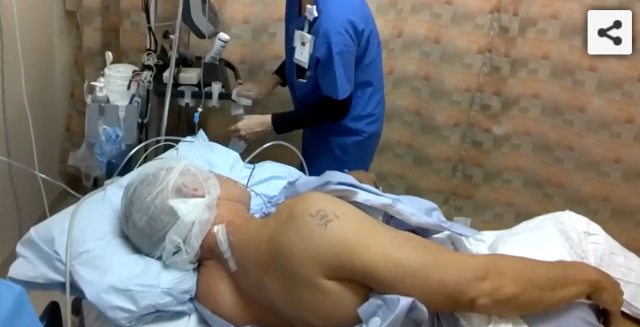
Interscalene Catheter with Google Glass by Dr. Brandon Winchester
A cleverly recorded ultrasound-guided interscalene catheter procedure. The block video was made exclusively with the video camera and microphone built into Google Glass. Possibly Google Glass may not have been used to record an ultrasound-guided interscalene nerve block or continuous catheter procedure yet! Enjoy, and special thanks to Dr. Brandon Winchester for hosting it public on www.blockjocks.comDr. Brandon Winchester LINK to video :http://www.blockjocks.com/fiaY/interscalene–catheter-with-google–glass

Becker’s Hospital Review published an article by Paul Paul R. Sierzenski, MD entitled Smarter Use of Imaging Technology Helps Reduce Hospital Errors and Healthcare Costs
February 9, 2015
The Good News About Healthcare Reform: Smarter Use of Imaging Technology Helps Reduce Hospital Errors, Healthcare Costs
Paul Sierzenski, MD
Medical errors continue to be a major problem in the US healthcare system, with hospital acquired infections (HAC) becoming an area of greater focus and where significant financial penalties are being incurred. Medicare has added one especially dangerous--or even potentially fatal--adverse event, iatrogenic pneumothorax during central line placement, to its HAC list. Along with putting patients in peril, the mistake can also increase…
Morocco Trial Shows Remote Ultrasound Can Expand Access and Improve Maternal Care.
In the remote reaches of rural areas and developing countries there is continuous demand to accessible solutions that provide reliable, faster, and affordable clinical care. Every day, around the world, approximately 800 women die from preventable causes related to pregnancy and childbirth. Of those deaths, 40 percent are due to injuries or conditions related to placenta complications. The only way to detect abnormal placenta challenges is through an ultrasound exam.
In the rural areas of Morocco, previously pregnant women had to wait up to two weeks to obtain the…
Studies Indicate CT Scan Overuse, Radiation Overexposure
Recently the medical literature has documented the growing use of CT scans. It is certainly no secret that, when circumstances warrant, Sonosite advocates for the consideration of ultrasound first over other imaging modalities. A CT scan is a powerful and valuable test when used appropriately and—as with all medical procedures—when its therapeutic value is carefully weighed against its potential harm. Yet, while acknowledging CT’s value, I can’t ignore mounting evidence indicating CT scans are being ordered more often than are necessary or safe.
According to a June 13, 2012, JAMA report…
ASA “Practise Guidelines for Central Venous Access” Published
It may be an exaggeration to suggest that every other month a new guideline or requirement is released by a professional medical body recommending or directing that ultrasound—especially bedside (a.k.a., point-of-care) ultrasound—be incorporated into clinical best practises, but often it feels like it.Case in point: In my last CMO Corner, I commented on the AIUM recognising the American College of Emergency Physician’s Policy Statement “Emergency Ultrasound Guidelines,” which acknowledged point-of-care ultrasound as part of emergency care’s best practises.Not long ago, new ACGME Programme…