


Answers to Common Questions About Ultrasound Transducers (Ultrasound Probes)
Whether you call them ultrasound transducers or ultrasound probes, these precision instruments are the foundation of every ultrasound exam. Below, FUJIFILM Sonosite answers the most frequently asked questions about how ultrasound transducers work, how to select the right one, and how to keep them performing reliably in demanding point-of-care environments.
Ultrasound “Transducer” or Ultrasound “Probe”—Which Term Is Correct?
Both are correct.
The term transducer describes the device’s scientific function—it transduces one form of energy (sound) into another (electrical). The word probe is often used informally and interchangeably, though it has become less common in recent years.
At Sonosite, we primarily use the term ultrasound transducer, while recognising that many clinicians still refer to it as an ultrasound probe. Both terms describe the same essential imaging tool.How Do Ultrasound Transducers Work?
An ultrasound transducer sends high-frequency sound waves into the body. These waves bounce off tissues and return as echoes. Inside the transducer, a ceramic piezoelectric element converts those echoes into an electric current. The ultrasound system’s computer then processes the signal to create an image in real time.
This continuous process of sending and receiving sound enables clinicians to visualise anatomy, guide interventions, and diagnose conditions safely and noninvasively.What Is Piezoelectricity?
Piezoelectricity is the physical principle that allows ultrasound imaging to work. Certain materials—such as piezoelectric ceramics—generate an electrical charge when compressed or vibrated by sound waves.
In medical ultrasound, these elements emit and receive ultrasonic frequencies ranging from 1–46 MHz, far above what the human ear can detect. The echoes that return from body tissues are converted to electrical signals, forming the ultrasound image.What Is Echogenicity?
Echogenicity describes how well a structure reflects ultrasound waves. It allows clinicians to distinguish tissue types and identify abnormalities.
- Hyperechoic — highly reflective, appearing bright or white (e.g., bone, fascia, connective tissue).
- Hypoechoic — moderately reflective, appearing gray (e.g., fat or muscle).
- Anechoic — does not reflect sound, appearing black (e.g., fluid-filled structures like the bladder).
These variations in echogenicity are what make ultrasound such a versatile diagnostic tool.
What Does “MHz” Mean in an Ultrasound Transducer?
MHz stands for megahertz, or one million cycles per second. It measures the frequency of the ultrasound waves.
- Ultra-High frequency transducers (46 MHz) designed specifically for intricate superficial anatomy, empowering clinicians with detailed insights.
- Low-frequency transducers (1–5 MHz) penetrate deeper into the body but offer lower spatial resolution.
- High-frequency transducers (10–20 MHz) provide detailed images of superficial structures but have limited depth penetration.
Most ultrasound transducers can operate across a range of frequencies to optimise image quality for different applications.
What Are the Different Types of Ultrasound Transducers (or Probes)?
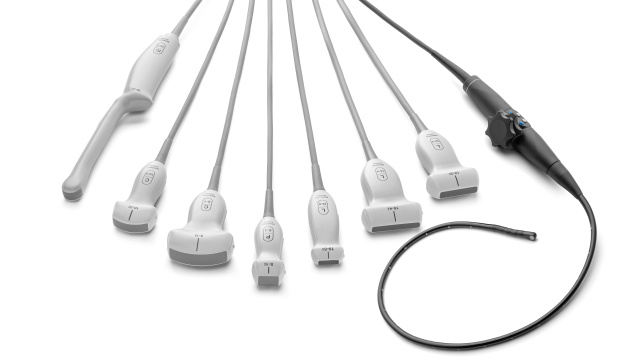
There are several common ultrasound probe types, each suited to specific clinical applications:
- Linear transducer: Flat footprint, high frequency; ideal for vascular, musculoskeletal, and nerve imaging.
- Curved or convex transducer: Curved face; used for abdominal, OB/GYN, and general imaging.
- Phased-array transducer: Small footprint, low frequency; optimised for cardiac and intercostal imaging.
- Endocavitary transducer: Designed for transvaginal or transrectal imaging, offering close access to internal organs.
Sonosite offers transducers across these categories to meet diverse point-of-care needs.
How Do I Choose the Right Ultrasound Transducer for My Application?
Selecting the right transducer depends on:
- Imaging depth — deeper structures require lower frequencies.
- Field of view — larger footprints capture more anatomy.
- Clinical use — e.g., linear for vascular access, curved for abdominal imaging.
- System compatibility — ensure the transducer matches your ultrasound machine model.
Sonosite’s transducer lineup is engineered to cover the full range of point-of-care imaging—from emergency and anaesthesia to obstetrics and sports medicine.
How Long Do Ultrasound Transducers Last?
With proper handling, transducers can function reliably for many years. However, lifespan depends on:
- Frequency of use
- Cleaning and disinfection practises
- Cable strain and drop exposure
FUJIFILM Sonosite designs its transducers to exceed stringent durability standards and backs them with an industry-leading warranty—the first of its kind in the ultrasound industry.
How Should I Clean and Disinfect an Ultrasound Transducer?
Always follow the manufacturer’s Instructions for Use (IFU). In general:
- Use only approved disinfectants compatible with the transducer’s materials.
- Avoid immersing connectors or non-sealed components.
- Inspect cables and lenses for wear before and after cleaning.
Sonosite provides detailed transducer care and cleaning guidelines to ensure both patient safety and device longevity.
Are Ultrasound Transducers Waterproof?
Most transducer heads are water-resistant, but not all are fully submersible. Waterproof ratings (such as IPX7 or IPX8) vary by model. Connectors and cables should never be submerged unless specified.
Sonosite’s transducers are built for rugged use, including exposure to fluids in challenging environments, but should always be cleaned according to manufacturer specifications.
Can Ultrasound Transducers Be Repaired or Refurbished?
Certain components, like outer housings or cables, can be repaired by qualified technicians. However, piezoelectric arrays and acoustic elements require precise calibration and should only be serviced by the manufacturer.
Sonosite offers factory-authorised repair and replacement options to maintain optimal performance and safety.
What Causes Ultrasound Transducer Image Quality to Degrade?
Common causes include:
- Cable fatigue or internal wire breaks
- Cracked acoustic lenses
- Poor gel coupling
- Connector corrosion
- Aging or damaged piezoelectric elements
If image artefacts or signal dropouts appear, contact Sonosite technical support for evaluation or replacement options.
Are All Ultrasound Probes Compatible With Any Ultrasound Machine?
No. Ultrasound transducers are typically system-specific due to differences in connectors, signal processing, and software optimisation.
Using the correct Sonosite-approved transducer ensures proper imaging performance, safety, and reliability.
What Is the Difference Between 2D, 3D, and Doppler Ultrasound Transducers?
- 2D transducers produce traditional grayscale images for structural assessment.
- 3D and 4D transducers capture volumetric data for applications such as obstetrics.
- Doppler transducers measure motion and blood flow, aiding vascular and cardiac assessments.
Many Sonosite transducers combine these modes, providing multipurpose imaging flexibility.
What Are Ultrasound Transducers Made Of?
A typical ultrasound transducer includes:
- A piezoelectric ceramic element that converts energy.
- Acoustic matching layers to optimise sound transmission.
- A protective acoustic lens and housing.
- A shielded cable to carry signals to the system.
Transducers are engineered to withstand repeated disinfection cycles and clinical use.
What Is the Difference Between Single-Crystal and Multi-Crystal Ultrasound Transducers?
Single-crystal transducers use a uniform crystal structure that produces stronger, purer sound waves, resulting in greater sensitivity and image resolution.
Multi-crystal (composite) transducers may be more cost-effective but offer slightly lower image clarity.
Sonosite’s advanced single-crystal technology helps deliver consistent diagnostic detail across a wide frequency range.
How Can I Tell If My Ultrasound Transducer Is Damaged?
Signs of damage include:
- Dropout lines or missing image segments
- Intermittent signal loss when the cable is moved
- Physical cracks or discolouration on the lens
- Visible damage to connectors
Routine inspection helps identify issues early. Contact Sonosite if you notice image artefacts or physical damage.
What Are Point-of-Care Ultrasound (POCUS) Transducers?
POCUS transducers are compact, durable probes designed for bedside and field use in emergency medicine, critical care, anaesthesia, and military applications.
Sonosite pioneered portable ultrasound and continues to lead in rugged, high-performance POCUS transducers built to withstand challenging clinical environments.
Can Ultrasound Transducers Be Sterilised?
Ultrasound transducers cannot be autoclaved, but sterile covers and approved disinfectants allow safe use in sterile fields. Always follow disinfection instructions located in the relevant equipment manufacturer user guide.
How Do Ultrasound Transducers Connect to Portable or Handheld Systems?
Transducers connect via cables, USB-C, or proprietary connectors, depending on the ultrasound system. Some modern designs use wireless or Bluetooth connectivity.
Sonosite’s portable and handheld systems support quick-connect transducers optimised for image quality and durability in the field.
Learn More
For a deeper scientific overview, see “Ultrasound Transducer Selection in Clinical Imaging Practise” on Wiley Online Library.
To explore FUJIFILM Sonosite’s full range of ultrasound transducers (probes) designed for reliability and precision, visit our Ultrasound Transducers page.